


The Devastating Consequences of Declining School
Editor’s Note: This blog post is part of an ongoing series of posts dedicated to K-12 education policy in Mississippi.
***

By Grace Breazeale | Director of Research and K-12 Policy
Mississippi experienced a steep decline in public school enrollment during the COVID-19 pandemic, and many schools have yet to experience the full consequences. Since enrollment is directly tied to school funding, a drop in students generally spells trouble for school budgets. The Federal Elementary and Secondary School Emergency Relief Fund (ESSER Fund) has filled in funding gaps over the last several years, but the expiration of this funding in September 2024 could leave some schools in perilous financial situations in the years that follow. Schools and local stakeholders—as well as the state at large—must be prepared for this financial fallout in order to mitigate its harm to students.
Falling Enrollment: Where Are The Students?
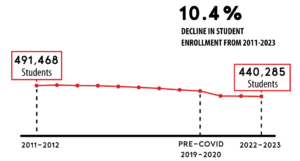
Mississippi’s public school system is no stranger to declining enrollment, which has been a continuous trend over the past decade. Even so, no one could have predicted the magnitude of the decline that took place between the 2019-2020 and 2020-2021 school years, when most school districts implemented some form of virtual learning in response to the pandemic. Despite hopes that enrollment would bounce back when schools transitioned back to in-person instruction, it continued to plunge.
Statewide Public School Enrollment
Where did students go?
The decline in student enrollment can partially be attributed to demographic trends. Between 2010 and 2021, the number of residents in the 5-to-19 age group declined by 6.6% due to outmigration from the state and declining birth rates.
The loss of students in the public school system can also be explained by increased participation in alternative schooling options, such as homeschooling. Data from the US Census Bureau reveals an 11.6 percentage point increase in the proportion of homeschooled students in Mississippi between May and September 2020, over twice the percentage point increase nationwide.1
Relationship with Teacher Shortages
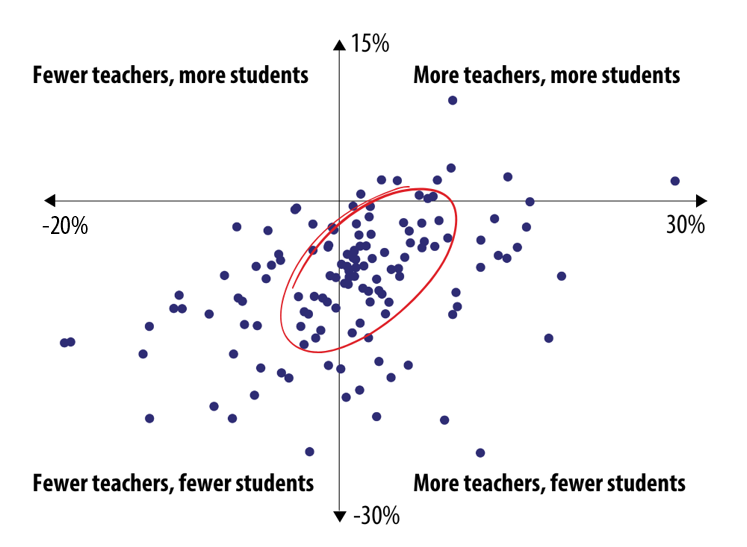
Teacher shortages have been a longstanding issue for the state’s public schools. Given that the number of teachers in a school is connected to the number of students, it is worth exploring the connection between teacher shortages and trends in student enrollment. Between the 2018-2019 and 2021-2022 school years, the number of full-time teachers in the public school system decreased by 0.7%, while the number of enrolled students dropped by 6.3%. The graph below shows how these figures vary across school districts in Mississippi (note that each point on the graph represents a different school district).
District Change in Teachers and Students from 2018-2019 to 2021-2022
Most school districts lost students—many in the range of 5% to 15%. In contrast, about half of school districts gained teachers, while about half lost teachers.
Data Source NCES
Why have teacher shortages persisted, despite the fact that declines in student enrollment have outweighed declines in the teacher workforce? In short, the supply and demand of licensed educators is more complex than a simple ratio of students to teachers in a given district. School districts may struggle to hire teachers in particular subject areas or particular schools within a district, even as the number of teachers in the district remains constant or increases. A district could have a high percentage of long-term substitutes or teachers on a provisional license; in the above figure, these individuals would still be counted as teachers in the districts.
Though not a perfect measure, the classification of critical shortage areas across the state captures some of the nuances of what it means for an area to have a teacher shortage. For a district to be classified as a critical shortage area, 15% of its teachers must not have a proper license (10% for districts with fewer than 60 teachers). Additionally, at least 30% of the district’s teacher workforce must have 25+ years of teaching experience. Despite gaining teachers and losing students, some school districts may be designated as geographical critical shortage areas because of high proportions of non-appropriately licensed teachers or older teachers. Given this definition, it is notable that the number of critical shortage areas in the state has more than doubled since the 2018-2019 school year, topping 100 districts for the first time in the current school year.
The relationship between student enrollment and the supply and demand of licensed educators is complex. In contrast, a loss in student enrollment has a clear implication: less school funding.
Financial Consequences of Declining Enrollment
As student enrollment declines, schools face significant financial challenges that may threaten the quality of education they provide for the students that remain.
Understanding Mississippi School Funding
The bulk of school funding comes from the Mississippi Adequate Education Program (MAEP), a statutory formula designed to ensure each district has the resources to provide an adequate education to its students. MAEP funding is distributed based on enrollment. In general, as enrollment falls, schools receive less funding. In rare cases, the state may pass a hold-harmless provision in which school districts may use enrollment prior to a decline to determine funding, but these only temporarily mitigate shortfalls.
MAEP is partially funded by the state and partially funded by local property taxes. The state has only met its funding obligations twice in the history of the funding formula, so schools are used to operating on a smaller amount. Even so, the size of the enrollment drop that occurred during the pandemic is unprecedented, and its impact on school finances has yet to be fully realized. For the past several years, districts have received large sums of federal ESSER funds, which they have been able to use to fill in some of the gaps caused by falling enrollment. ESSER funds expire in September 2024. Once these funds are no longer available, schools will face severe financial pressures that could force them to cut non-essential courses and extracurricular programs. Districts in the most precarious financial situations may have to close down schools or even consolidate.
The impact of decreased funding will be particularly acute for “property-poor” districts, due to the structure of the MAEP program. While “property-rich” districts—i.e., districts with higher property tax values—have the ability to provide substantial funds above what is mandated by the MAEP program, property-poor districts often, by definition, do not have these resources. In short, the consequences of decreasing enrollment on school funding are grave and may have long-lasting effects on the quality of education that Mississippi’s schools are able to provide—particularly for the students in the least-advantaged school districts.
Equity Implications of Declining Enrollment
Mississippi has a troubling history of enrollment trends driving inequitable funding in its public school system. When the Supreme Court ordered the state’s public schools to comply with integration orders in 1969, private “white flight” academies sprung up, effectively allowing segregation to continue. The private schools were majority white, while the public school system was majority Black. At this point, the state legislature began to lose an appetite for investment in the public school system, which has persisted. Even when the state legislature has managed to pass laws that appear to benefit schools, they have often failed to follow through with ongoing investment or proper implementation. MAEP, for example, was written to ensure more equitable funding for public school students—but has only been fully funded twice since 1997. Additionally, MAEP leaves room for more affluent areas to provide higher funding for their schools via property taxes.
At-A-Glance: Jackson Public Schools
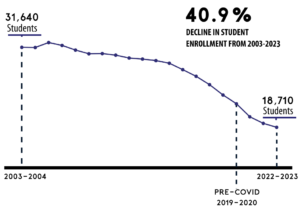
Contemporary challenges facing Jackson Public Schools (JPS) exemplify a continuation of old patterns. In the past decade, the district has seen a sharp increase in students leaving to enroll in suburban public schools, private schools, and homeschooling—or even leaving the state entirely.
Jackson Public School Enrollment from 2003-2004 to 2022-2023.
Looking to the Future
As demographic trends and outmigration persist, student enrollment will likely continue to fall in many districts across the state.
Districts Need to Develop Contingency Plans
School districts must be prepared to handle the financial impact of this, which they can do through examining their budgets and finding ways to optimize the efficiency of their budgets . Moreover, they should develop detailed contingency plans that minimize disruptions to students and the community in the event of school closures or district consolidations. Though consolidations can be bumpy, intentional planning and preparation can help to ensure that they are as smooth and efficient as possible. The relatively successful consolidation of the Starkville and Oktibbeha school districts in 2015 exemplifies how the process does not have to be turbulent.
Grow School Funding
While it may be tempting for the state to use declining student enrollment as an excuse to deprioritize teacher retention or continue underfunding MAEP, this would be a mistake. Mississippi’s teacher shortage has been a critical issue over the past several years, with a growing number of critical shortage areas, a sharp uptick in teacher turnover, and 2,593 certified teacher vacancies reported by MDE for the 2022-2023 school year. Schools are only as strong as their teachers, so shifting focus away from teacher retention could exacerbate school enrollment issues. In terms of funding, having fewer students will mean that schools will be owed a smaller amount of MAEP funding; this could be an opportunity for the state legislature to finally meet its obligations by providing the total amount owed to schools.
Districts Should Engage Families to Understand Why Students are Leaving the District
Lastly, district leaders should prioritize engaging with families in the community to learn more about why students are leaving the districts. Through these conversations, they should identify areas of discontent and then strategize about ways in which they could target these areas. While some of the decreased enrollment results from outmigration and lower birth rates, increasing rates of homeschooling demonstrate that some of the decreases have to do with parents’ choices to remove their children from public schools. Honest discussions with parents could contribute to identifying strategies that help increase enrollment, benefiting both school districts and the students they serve.
1Data on private school enrollment during this time period is unavailable.
Related Posts
By Grace Breazeale, Director of Research and K-12 Policy On May 22, the U.S. House of Representatives passed a sweeping domestic policy bill, H.R.1 (the One Big Beautiful Bill Act). If the bill is passed by the Senate and signed into law, it could indirectly lower the amount of state funding that school districts receive and reduce […]

This post is part of our ongoing analysis of 2024 education legislation. See our bill tracker here for all analyses. Mississippi First has spent the last year closely researching the impact of MAEP on districts throughout the state in order to determine how best to direct additional resources to students with the greatest needs. Having built up […]

This post is part of our ongoing analysis of 2024 education legislation. See our bill tracker here for all analyses. In the 2024 legislative session, lawmakers have introduced two separate school funding proposals that each promise to inject at least an additional $200 million into funding for public education in Mississippi, with the House plan providing about […]
Editor’s Note: This blog post is part of an ongoing series of posts dedicated to K-12 education policy in Mississippi. *** By Grace Breazeale | K-12 Policy Associate In this Post: How We Meet the Needs of English Language Learners Mississippi’s population of students who identify as English Language Learners (ELLs) has grown in recent decades, […]

Editor’s Note: This blog post is part of an ongoing series of posts dedicated to K-12 education policy in Mississippi. *** By Grace Breazeale | Director of Research and K-12 Policy As most districts welcomed students back to school in August, districts on a balanced academic calendar were already going into their second month of the […]

Editor’s Note: This blog post is part of an ongoing series of posts dedicated to K-12 education policy in Mississippi. *** By Grace Breazeale | Director of Research and K-12 Policy Mississippi’s high school graduation rate has steadily risen over the past five years, which would typically be a cause for celebration. But in this case, […]

By Micayla Tatum, Director of Early Childhood Policy After four legislative sessions, we are excited to announce that our bill to permanently raise the per-pupil funding rate, HB 817, passed! The Governor signed the bill into law on April 17. This bill increases the state share of per-pupil pre-K funds from $2,150 to a minimum of $2,500 per […]
Editor’s Note: This blog post is part of an ongoing series of posts dedicated to K-12 education policy in Mississippi. *** By Grace Breazeale | Director of Research and K-12 Policy In early 2021, the Mississippi Department of Education released its first-ever social-emotional learning (SEL) standards. The release of these standards was a positive step towards increasing […]

Editor’s Note: This blog post is a part of a new ongoing series of posts dedicated to K-12 education policy in Mississippi. *** By Grace Breazeale I K-12 Policy Associate In this Post: Roadblock to Recovery: Student Absenteeism As school districts take steps to recover from pandemic learning loss, they should not underestimate how rising rates […]

By Rachel Canter | Executive Director Mississippi First has published a public memo to the State Board of Education to support the selection of a new state superintendent. This choice will not only be the most important decision the State Board makes this year; it will also be the most important decision they will make in the […]

Editor’s Note: This is a personal reflection by Rachel Canter in response to the tragedy in Uvalde. It reflects her thoughts and feelings alone. It was originally published in an email. By Rachel Canter | Executive Director There are no sacred spaces left in America. This is the thought I keep coming back to after the […]

The 2022 legislative session was a wild ride for pre-K. Our bill to permanently change the per-pupil funding rate, HB 1246, died late in the session due to unrelated politics. This bill would have increased the state share of per-pupil pre-K funds from $2,150 to $2,500 per child—an increase of $350 per child in state funds […]