



Examining Attrition Risk for State-Tested Teachers
Editor’s Note: This blog post is a part of a new ongoing series of posts dedicated to K-12 education policy in Mississippi.
***

By Grace Breazeale | Director of Research and K-12 Policy
Among the challenges complicating Mississippi’s progress toward achieving its long-term education goals may be an unusually high rate of teacher turnover in the very subjects for which it conducts standardized assessments. Results from the 2022 Mississippi Teacher Survey demonstrate that teachers in state-tested subject areas are significantly more likely to report plans to leave their teaching position by the end of the school year than their colleagues in non-state-tested subjects.
To be sure, Mississippi has enjoyed some good news on the state testing front recently: results from the 2021-2022 school year indicate that teachers and their students overcame two years of pandemic-related challenges to report scores comparable to pre-pandemic levels. This is undoubtedly a testament to the resilience and determination of everyone involved. But as Mississippi looks to move past the pandemic and toward its long-term goals—in particular its goal for 70% of students to reach proficiency in ELA and math by 2025—it is worth examining what barriers remain to further progress.
One obvious barrier is Mississippi’s ongoing teacher shortage. Statewide, 104 out of 148 school districts are classified as “critical shortage areas” due to their challenges in hiring teachers in any subject. However, teachers in state-tested areas are in charge of delivering instruction in some of the most foundational subjects—math, ELA, science, and history—and the progress of their students plays an outsize role in metrics used by the Mississippi Statewide Accountability System. Unusually high attrition risk in these areas threatens progress at all levels, from individual student growth to meeting statewide proficiency goals. What explains the higher attrition risk for teachers in state-tested subjects, and what does it mean for Mississippi students?
Insights from the 2022 Mississippi Teacher Survey
In November 2021, we surveyed 6,496 teachers across Mississippi to better understand teachers’ experiences and perspectives on the educator pipeline. Among other analyses (to be released in a forthcoming report), the resulting data allows us to examine differences in attrition risk between state-tested and non-state-tested teachers. For the purposes of this post, we chose to focus our analyses on teachers in grades 3-8, narrowing our sample to 3,220 respondents. The group of state-tested teachers includes those who teach 3rd-8th grade math or ELA, 5th grade science, or 8th grade science. The group of non-state-tested teachers includes those who teach any other subject in grades 3-8.
To measure attrition risk, we looked at the proportion of teachers in each group whose survey responses indicate that they are “somewhat likely” or “very likely” to exit their classroom position (as of November 2021) within the next year to teach in another state, obtain a different role in education, or exit the education field entirely. We refer to these individuals as “likely leavers.” We measure a group’s attrition risk by determining its percentage of likely leavers.
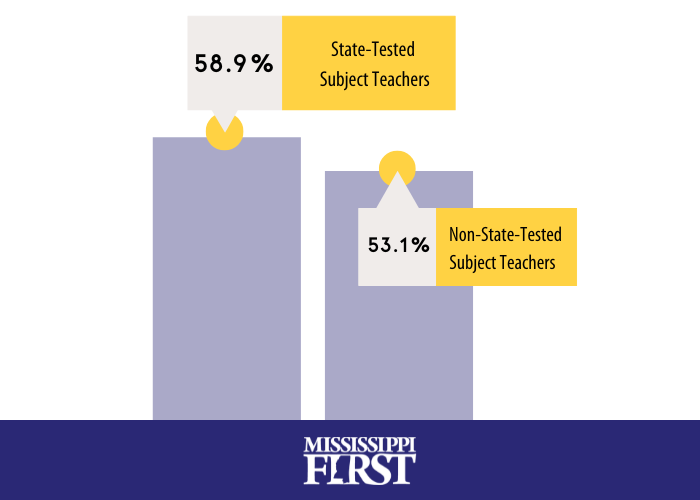
We find that the attrition risk of state-tested teachers is almost 6 percentage points higher than the attrition risk of their peers: 58.9% of teachers in state-tested subjects are likely leavers, compared to 53.1% of teachers in non-state-tested subjects. The difference in these rates is statistically significant, meaning that it cannot be attributed to chance.
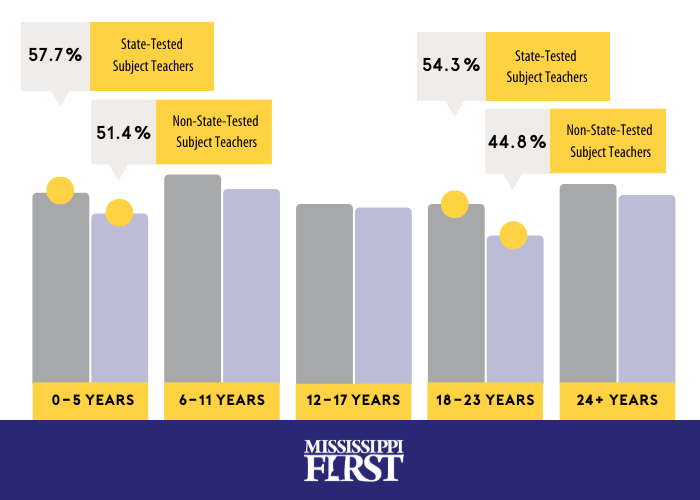
We have observed elsewhere in our survey data that attrition risk is related to the length of one’s teaching experience: there appears to be an increase in attrition risk in the early stages of a teacher’s career, followed by a decrease in the middle stages of their career that continues until they reach retirement age. Considering this trend, we were interested to see how attrition risk varies between state-tested and non-state-tested teachers within different career stages. As the graph below demonstrates, attrition risk appears to be higher among teachers in state-tested subjects across all levels of experience; however, these differences are only statistically significant for teachers with 0-5 years of experience, and for teachers with 18-23 years of experience.
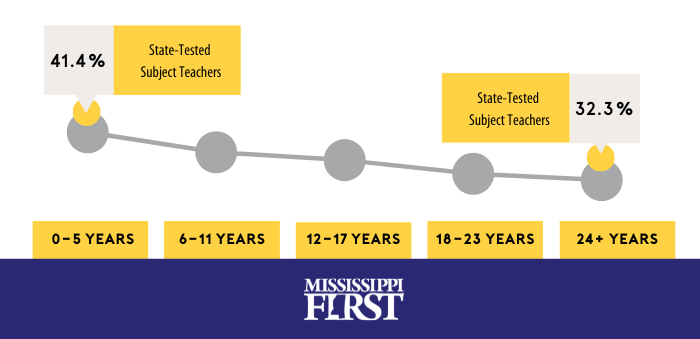
This finding leads us to predict teachers are most likely to teach in state-tested subjects in the first years of their career and least likely in the last years of their career. Our data appear to verify this pattern. The graph below demonstrates that the group of early career teachers (0-5 years of experience) has the highest proportion of teachers in state-tested subjects. This proportion decreases with each successive experience level. In other words, the least-experienced teachers within a school have the highest probability of teaching state-tested subjects, while the most-experienced teachers have the lowest probability of teaching these subjects.
What do these trends mean for Mississippi schools?
We cannot definitively conclude that teaching a state-tested subject is a direct cause of attrition, but it is nonetheless associated with a desire to exit the classroom. Based on past research, this could be due to factors such as decreased flexibility, increased pressure from school and district leaders, and the resulting burnout. But regardless of the specific reasons for this pattern, increased attrition risk for state-tested teachers is troubling, particularly if the desire to leave translates to a higher turnover rate for these teachers. Increased turnover has been shown to negatively impact student achievement in ELA and math, and it can be particularly detrimental in schools that have large populations of low-performing students and Black students. Unfortunately, we already see the highest rates of turnover at these types of schools.
There are multiple avenues through which high turnover can impact student achievement. To name one, teachers who quit are often replaced with new, inexperienced teachers. This pattern holds relevance for our analyses, as we observe that state-tested teachers’ high attrition risk has likely contributed to a workforce in which early-career educators are most likely to teach state-tested subjects. Experience is an important element of teacher quality, and there is a particularly large learning curve in the first several years of a teacher’s career. Numerous studies have found that the experience of ELA and math teachers is positively correlated with student achievement on standardized tests. The experience level of teachers in these subjects has also been demonstrated to impact non-test-related outcomes, such as student absenteeism. Students are at a disadvantage if teachers with the least experience are placed in these subjects at the highest rates.
This brings us to a larger point: the consequences of teacher shortages fall most heavily on our students. We owe it to them to work towards solving this issue. Teaching a state-tested subject is one among many forces that is connected to a teacher’s risk of attrition. At Mississippi First, we are in the process of disentangling more of these factors and using our analyses to develop targeted policy solutions. We look forward to sharing more of this work in the coming months.
Related Posts

Note: This information is current as of 11:00am on Thursday, March 12. Teacher pay has been a major topic during the 2026 legislative session, with both the House and Senate advancing proposals to increase compensation for Mississippi’s educators. As the session has progressed, however, the path forward has become increasingly complicated. Multiple bills, amendments, and […]

After yesterday’s legislative committee deadline, all bills that would have led to a pay raise for Mississippi teachers are now dead. While not all hope is lost, the pathway to a permanent raise has narrowed. We are extremely disappointed that this long-overdue salary increase may become a casualty of political infighting. Earlier this year, Mississippi […]

FOR IMMEDIATE RELEASEMississippi FirstKrystal CormackDirector of Communicationskrystal@mississippifirst.org601.398.9008 Jackson, Mississippi—Today, Mississippi First released its newest report, The Weight They Carry: Life as a Teacher in Mississippi, an analysis of the conditions shaping Mississippi teachers’ day-to-day experiences and their decisions about whether to remain in the classroom. Based on survey responses from nearly 1,000 Mississippi teachers across […]

Editor’s Note: This blog post is part of an ongoing series of posts dedicated to K-12 education policy in Mississippi. *** By Grace Breazeale | Director of Research and K-12 Policy The Potential of Career Advancement Opportunities for Teachers Despite recent wins for public education in Mississippi, maintaining a strong and stable teacher workforce remains an issue. According […]

By Toren Ballard For the second year in a row, results from the Mississippi Academic Assessment Program (MAAP) exams suggest that Mississippi is continuing to defy nationwide trends in educational achievement: proficiency levels across all subjects were at all-time highs in 2023, and Mississippi is now one of just two states nationwide to have exceeded its pre-pandemic proficiency […]

Editor’s Note: This blog post is part of an ongoing series of posts dedicated to K-12 education policy in Mississippi. *** By Grace Breazeale | Director of Research and K-12 Policy In this Post: What Factors Influence a Teacher’s Salary? In recent reports—including Falling Behind, which we released earlier this month—we have presented evidence that a […]

Jackson, Mississippi—Mississippi First, a non-profit organization dedicated to improving education in the state, has released a new report titled Falling Behind: Teacher Compensation and the Race Against Inflation. The report provides a comprehensive look at the complex factors contributing to Mississippi’s teacher shortage with emphasis on how inflation has directly affected the impact of the recent […]

Editor’s Note: This blog post is part of an ongoing series of posts dedicated to K-12 education policy in Mississippi. *** By Grace Breazeale | Director of Research and K-12 Policy A growing body of research indicates that students of color benefit when their race or ethnicity is represented in the teacher workforce. Unfortunately, Mississippi’s teacher workforce does not reflect the […]

Editor’s Note: This post is one in an ongoing series of posts dedicated to early education policy in Mississippi. *** By Micayla Tatum, Director of Early Childhood Policy A lack of wage parity is a longstanding issue in the early childhood profession. Childcare teachers, Head Start teachers, and public pre-K teachers have vastly different salaries and access […]

Editor’s Note: This blog post is a part of a new ongoing series of posts dedicated to K-12 education policy in Mississippi. *** By Grace Breazeale | Director of Research and K-12 Policy Teacher compensation has rightfully taken center stage in the effort to address the teacher shortage crisis in Mississippi. Still, there remains a host […]

Editor’s Note: This post is one in an ongoing series of posts dedicated to early education policy in Mississippi. *** By Micayla Tatum, Director of Early Childhood Policy The educator pipeline crisis, which Mississippi First has researched extensively, also affects childcare centers, Head Start, and public school pre-K programs. In short, finding early childhood teachers is as […]

Jackson, MS—Today, Mississippi First released our newest report, Eyeing the Exit: Teacher Turnover and What We Can Do About It. This report takes a deeper dive into data first reported in our February 2022 report Voices of the Shortage: 2022 Mississippi Teacher Survey, which revealed that over half of teachers surveyed reported being “somewhat” or “very likely” to […]