



The Leadership Shuffle: Exploring Turnover in Mississippi’s Principal Workforce
Editor’s Note: This blog post is a part of a new ongoing series of posts dedicated to K-12 education policy in Mississippi.
***

By Grace Breazeale | Director of Research and K-12 Policy
School and district leaders can be heavily influential in shaping the experiences of teachers, who in turn influence the strength of the educator pipeline. This impact was recently reflected in the 2022 Mississippi Teacher Survey, in which the vast majority of respondents (86.2%) reported that school and district leadership have “some” or “a great deal” of impact on their career plans—including whether or not to remain in the classroom. It stands to reason, then, that cultivating and maintaining a stable, high-quality leadership workforce plays a key role in maintaining a similarly stable, high-quality teacher workforce.
The stability of the leadership workforce is closely related to principals’ longevity in their positions. As a principal spends more time in their role, they tend to get better at it. School staff also benefit from having consistent systems and expectations each year, which can be disrupted by sudden or frequent changes in leadership. Of course, the amount of time that a principal spends in their role is not the only determinant of quality: a school can have an excellent first-year principal, or an ineffective principal who has been in the position for years. But as one of the easiest attributes of quality to measure, longevity can be a useful starting point in examining the composition of a principal workforce.
To better understand the state of school leadership in Mississippi, we have analyzed four years’ worth of principal contact information provided by the Mississippi Department of Education to gauge longevity among Mississippi principals and the prevalence of administrative turnover. In this post, we will outline the proportions of principals who are in the first years of their positions, and we will describe school characteristics that appear to be related to principal turnover. Then, we will explain the significance of turnover as it relates to school achievement and provide ideas about strategies to target this issue.
Over one-fifth of Mississippi principals are in the first year of their role.
Mississippi had a principal turnover rate of 22.8% in 2021-2022, meaning that roughly one out of five schools had a different principal in the 2022-2023 school year than they did in 2021-2022.1 Turnover rates from prior years reveal that this level of turnover is merely the continuation of a years-long pattern: 23.1% of principals did not return after 2020-2021, and 22.9% did not return after 2019-2020. (Data for previous years were unavailable).
National data on principal turnover indicates that Mississippi’s high rates of principal turnover do not make our state an outlier. The National Center for Education Statistics (NCES) reports national principal turnover rates of 18% in 2015-2016, 23% in 2012-2013, and 21% in 2008-2009. Without updated national data (and without archived Mississippi data) we cannot definitively conclude how Mississippi compares to national turnover rates, but it seems plausible that recent rates are at least in the ballpark of nationwide figures. Unfortunately, with the most recent reported national rate of 18% being viewed as “staggeringly high,” we should assume that the rate of principal turnover in Mississippi is a cause for deep concern.
In practice, a consistently high turnover rate means that, in any given year, large proportions of Mississippi principals are likely only a year or two into their tenure, and that large proportions of Mississippi schools have recently experienced a change in leadership.2 In addition to 22.8% of principals being in their first year of their position, 19.1% of principals are in their second year and 14.9% are in their third. Altogether, over half of principals in Mississippi (56.8%) are somewhere in the first three years of their position at their current school. In other words, the majority of schools in the state experienced at least one change in leadership over the past three years. An alarming 12.5% of schools experienced more than one change in leadership over the past three years, meaning they have had three or more leaders since the 2019-2020 school year. Unfortunately, high levels of principal turnover appear to be hitting schools with the greatest need for high-quality leadership the hardest.
Low-performing schools and Title I schools experience the most turnover.
Schools with low accountability ratings have the highest rates of teacher turnover, and this pattern also applies to principals. Among schools in Mississippi that received a “C,” “D,” or “F” rating in 2019, 61.1% currently have a principal in their first three years in the position, compared to 50.9% of A-rated and B-rated schools. This is consistent with national research, which also shows a higher frequency of leadership changes among lower-performing schools.
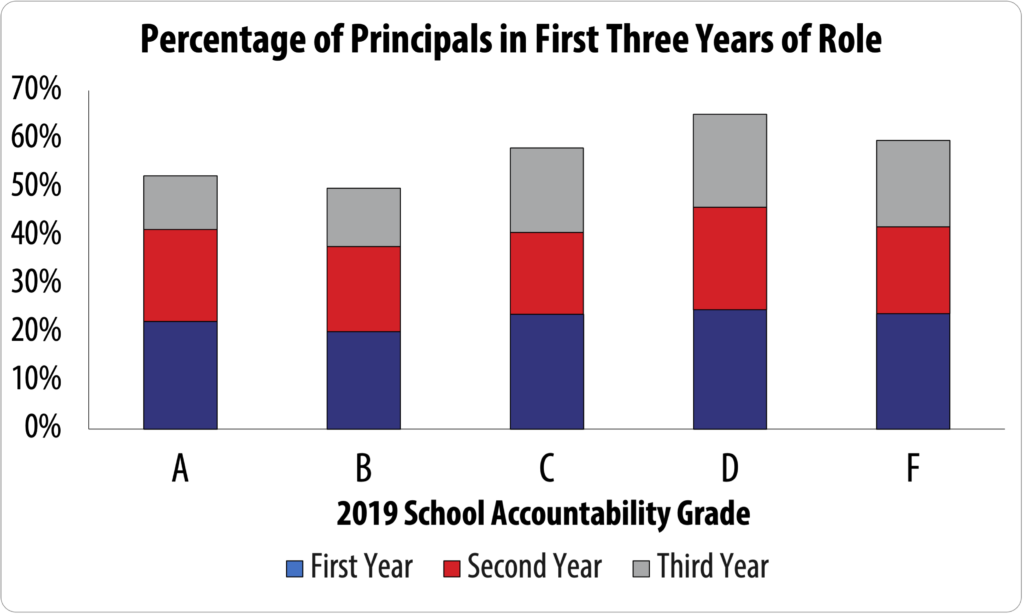
Schools that receive Title I funds, which have higher proportions of students from economically-disadvantaged backgrounds, have higher rates of principal turnover than schools that do not receive Title I funds. This finding is also consistent with national research, which shows that schools with high percentages of low-income students are most likely to experience leadership changes.
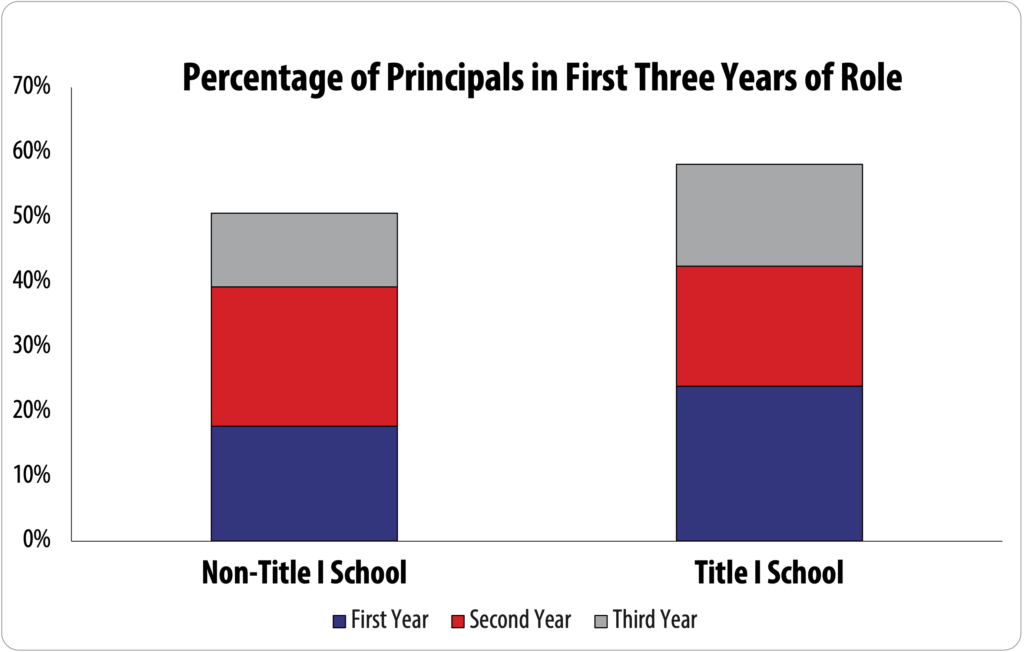
Our findings indicate that turnover is highest at schools where student achievement is low and resources are scarce. Are principals exiting because of these challenges, or do these challenges exist in part due to high leadership turnover? Research shows that both are true: the accountability pressures and limited resources of these schools can play a role in pushing principals out, while frequent changes in leadership can contribute to the schools’ struggles.
What does high principal turnover mean for schools?
Principal turnover represents yet another roadblock to building high-achieving schools in Mississippi: research suggests that disruptions caused by leadership changes are associated with increases in teacher attrition and decreases in student scores. These events have a particularly strong effect in “high-poverty, low-achieving schools.” As we demonstrated above, these are the schools that are most likely to experience changes in leadership. They are also the schools most in need of strong leadership to help bolster student achievement.
Note that some schools may benefit from a principal’s departure. Not all principals are up for the job, and sometimes districts must initiate changes in leadership to improve school quality. If a school is able to replace a low-performing leader with a higher-performing one, this can mitigate the disruption of the leadership change on student achievement. However, in order for this to occur, the schools must have access to high-performing leaders who are willing to stay in the position for the long haul. The frequency of schools in Mississippi that have experienced two or more leadership changes in the past three years indicates that such access is lacking in the state. There appears to be a weak pipeline of principals who are willing to stay in their schools.
How Can We Chart a Path Forward?
To address the trend of over one-fifth of Mississippi principals not returning to their positions each year, we will need a better understanding of the drivers behind these high rates of turnover. We can gauge the general rate of attrition, but ultimately policymakers need more useful information: Do most principals leave involuntarily, or on their own volition? If they left voluntarily, why did they go? If not, why were they forced out? What are common professional destinations for principals leaving Mississippi schools?
Different causes of attrition will require different solutions: if principals are leaving involuntarily due to low performance, for example, districts may choose to invest in more useful professional development opportunities for leaders. If principals are choosing to leave because they do not have a sufficient amount of decision-making power, districts could consider ways in which they can provide more autonomy. A 2019 literature review conducted by the Learning Policy Institute (LPI) classifies reasons for attrition under five primary categories, each with general corresponding solutions to reduce turnover:
| Reason for Turnover | Potential Solutions to Reduce Turnover |
| Inadequate job preparation/professional development | Increase quality of leadership preparation programs; increase access to on-the-job training and mentoring programs. |
| Poor working conditions | Direct more funding to schools to increase access to classroom resources; direct more support to principals from the district’s central office. |
| Salary does not match job responsibilities | Evaluate, and potentially reform, salary structure. |
| Lack of decision-making authority | Give principals more autonomy over personnel, budget, and school conditions. |
| High-stakes accountability policies | Reform accountability systems to make them less punitive and more supportive. |
This information provides a useful starting point for charting future strategies, as there is likely overlap between the drivers of turnover identified by LPI and the state of the principal profession in Mississippi. Still, in order to develop targeted strategies to strengthen and maintain the principal pipeline, it will be necessary to tease out where this overlap is. That’s where additional information and data on principal turnover becomes necessary. One thing is clear: school leadership matters. A principal’s leadership impacts everyone in the school building, and it can have a ripple effect that makes or breaks a school’s success. Taking steps to determine how best to increase longevity and improve the quality of leaders will be key in building high-achieving schools across Mississippi.
1 Turnover occurs if a principal voluntarily departs their school, or if they are fired from their position. Our data did not allow us to determine the percentage of departures that fell into each category.
2 Note that when we discuss principals being in the first year of their role, we are referring to their role at a specific school. This does not necessarily mean that they are first-year principals, as they could have previously served as principal of a different school.
Related Posts

Note: This information is current as of 11:00am on Thursday, March 12. Teacher pay has been a major topic during the 2026 legislative session, with both the House and Senate advancing proposals to increase compensation for Mississippi’s educators. As the session has progressed, however, the path forward has become increasingly complicated. Multiple bills, amendments, and […]

After yesterday’s legislative committee deadline, all bills that would have led to a pay raise for Mississippi teachers are now dead. While not all hope is lost, the pathway to a permanent raise has narrowed. We are extremely disappointed that this long-overdue salary increase may become a casualty of political infighting. Earlier this year, Mississippi […]

FOR IMMEDIATE RELEASEMississippi FirstKrystal CormackDirector of Communicationskrystal@mississippifirst.org601.398.9008 Jackson, Mississippi—Today, Mississippi First released its newest report, The Weight They Carry: Life as a Teacher in Mississippi, an analysis of the conditions shaping Mississippi teachers’ day-to-day experiences and their decisions about whether to remain in the classroom. Based on survey responses from nearly 1,000 Mississippi teachers across […]

Editor’s Note: This blog post is part of an ongoing series of posts dedicated to K-12 education policy in Mississippi. *** By Grace Breazeale | Director of Research and K-12 Policy The Potential of Career Advancement Opportunities for Teachers Despite recent wins for public education in Mississippi, maintaining a strong and stable teacher workforce remains an issue. According […]

By Toren Ballard For the second year in a row, results from the Mississippi Academic Assessment Program (MAAP) exams suggest that Mississippi is continuing to defy nationwide trends in educational achievement: proficiency levels across all subjects were at all-time highs in 2023, and Mississippi is now one of just two states nationwide to have exceeded its pre-pandemic proficiency […]

Editor’s Note: This blog post is part of an ongoing series of posts dedicated to K-12 education policy in Mississippi. *** By Grace Breazeale | Director of Research and K-12 Policy In this Post: What Factors Influence a Teacher’s Salary? In recent reports—including Falling Behind, which we released earlier this month—we have presented evidence that a […]

Jackson, Mississippi—Mississippi First, a non-profit organization dedicated to improving education in the state, has released a new report titled Falling Behind: Teacher Compensation and the Race Against Inflation. The report provides a comprehensive look at the complex factors contributing to Mississippi’s teacher shortage with emphasis on how inflation has directly affected the impact of the recent […]

Editor’s Note: This blog post is part of an ongoing series of posts dedicated to K-12 education policy in Mississippi. *** By Grace Breazeale | Director of Research and K-12 Policy A growing body of research indicates that students of color benefit when their race or ethnicity is represented in the teacher workforce. Unfortunately, Mississippi’s teacher workforce does not reflect the […]

Editor’s Note: This post is one in an ongoing series of posts dedicated to early education policy in Mississippi. *** By Micayla Tatum, Director of Early Childhood Policy A lack of wage parity is a longstanding issue in the early childhood profession. Childcare teachers, Head Start teachers, and public pre-K teachers have vastly different salaries and access […]

Editor’s Note: This blog post is a part of a new ongoing series of posts dedicated to K-12 education policy in Mississippi. *** By Grace Breazeale | Director of Research and K-12 Policy Teacher compensation has rightfully taken center stage in the effort to address the teacher shortage crisis in Mississippi. Still, there remains a host […]

Editor’s Note: This post is one in an ongoing series of posts dedicated to early education policy in Mississippi. *** By Micayla Tatum, Director of Early Childhood Policy The educator pipeline crisis, which Mississippi First has researched extensively, also affects childcare centers, Head Start, and public school pre-K programs. In short, finding early childhood teachers is as […]

Jackson, MS—Today, Mississippi First released our newest report, Eyeing the Exit: Teacher Turnover and What We Can Do About It. This report takes a deeper dive into data first reported in our February 2022 report Voices of the Shortage: 2022 Mississippi Teacher Survey, which revealed that over half of teachers surveyed reported being “somewhat” or “very likely” to […]