



Mississippi’s Pre-K Celebrated Nationally for Quality

Since 2013, Mississippi First has been dedicated to increasing access and quality to public pre-K across the state. This week, the National Institute for Early Education Research (NIEER) announced that Mississippi is one of the top six states for high-quality pre-K.
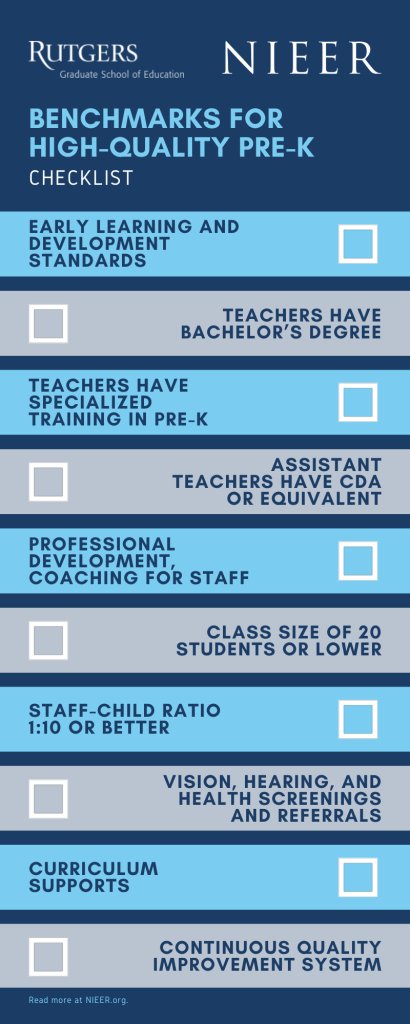
These accolades are well deserved as Mississippi pre-K students continue to outperform their peers when entering kindergarten. Mississippi ensures quality by requiring all early learning collaboratives (ELCs) to meet the 10 NIEER benchmarks. This year, HB1123 upgraded the law to include new benchmarks NIEER unveiled in 2017.
The hard work of ELCs combined with the legislature’s commitment during the last two legislative sessions to increase per-pupil funding from $4,300 to $5,000 per child makes maintaining high-quality pre-K attainable. The per-pupil funding increase has been critical for our current pre-K programs, especially as they navigate the pandemic. We know this raise increase needs to be made permanent in 2022.
Permanently increasing per-pupil funding to $5,000 per child gives ELCs the best chance of success long-term. A quality classroom in Mississippi costs $100,000, not including any administrative costs. Current law only guarantees each classroom $86,000. For the last two years, we have relied on year-to-year budget clarifications to ensure classrooms receive a full $5,000. Without the fix, collaboratives will be back to either raising more money than their fair share or looking for ways to cut costs, and that pressure may eventually lead to cutting corners on quality.
We are excited that Mississippi’s pre-K program is getting the praise it deserves for quality nationally. Now, we need to make the push to maintain the increase of per-pupil funding so ELCs can continue to have the resources they need to provide high-quality pre-K to Mississippi’s four-year-olds!
Related Posts

Mississippi’s Early Learning Collaboratives (ELCs) are #1 in the country for their high-quality pre-K programs. The ELCs currently operate in 40 communities and serve over 6,000 students. ELCs involve many partners, including school districts, Head Start programs, and licensed childcare providers. These partners commit to working together to provide high-quality pre-K to Mississippi’s four-year-olds. Despite our […]

Takisha Bishop, a business owner and childcare provider in Greenwood, MS, discusses the impact of the losing voucher students on her business and community.
Mississippi First is continuing its campaign to elevate the voices of real Mississippians who are highlighting the urgent childcare needs across our state. High-quality childcare is essential for children, working families, and our state’s economic future—but today, too many Mississippi families struggle to access or afford the care they need. Our video series spotlights real […]
Mississippi First is continuing its campaign to elevate the voices of real Mississippians who are highlighting the urgent childcare needs across our state. High-quality childcare is essential for children, working families, and our state’s economic future—but today, too many Mississippi families struggle to access or afford the care they need. Our video series spotlights real […]
Mississippi First is launching a new video campaign calling for increased appropriations to Mississippi’s Child Care Payment Program. High-quality childcare is essential for children, working families, and our state’s economic future—but today, too many Mississippi families struggle to access or afford the care they need. Our video series will spotlight real stories from families and […]
Editor’s Note: This post is one in an ongoing series of posts dedicated to the federal role in early childhood in Mississippi. By Micayla Tatum, Director of Early Childhood Policy This blog post is the third in a series that highlights the impact of federal funding for early childhood on both families and communities throughout […]

Editor’s Note: This post is one in an ongoing series of posts dedicated to the federal role in early childhood in Mississippi. By Micayla Tatum, Director of Early Childhood Policy We want to continue to explore the impact of federal early childhood programs in Mississippi. This blog post is the second in a series that […]

By Micayla Tatum, Director of Early Childhood Policy When the legislative session came to a close on Thursday, April 3, 2025, the legislature went home without passing a budget for the state government, including an appropriations bill for the Mississippi Department of Education (MDE) and the Mississippi Department of Human Services (DHS). On Wednesday, May […]

Editor’s Note: This post is one in an ongoing series of posts dedicated to the federal role in early childhood in Mississippi. By Micayla Tatum, Director of Early Childhood Policy As Congress weighs funding decisions for fiscal year 2026, we want to explore the impact of federal early childhood programs in Mississippi. This blog post […]

Jackson, Mississippi—Mississippi First is proud to announce the release of its newest report, 2023 Public Perception of Early Childhood Education in Mississippi, which provides valuable insights into Mississippians’ views on the importance, affordability, and accessibility of early childhood education. The survey results underscore the widespread public support for pre-K and early learning initiatives across the state. […]

Editor’s Note: This post is one in an ongoing series of posts dedicated to early education policy in Mississippi. *** By Micayla Tatum, Director of Early Childhood Policy A lack of wage parity is a longstanding issue in the early childhood profession. Childcare teachers, Head Start teachers, and public pre-K teachers have vastly different salaries and access […]

By Micayla Tatum, Director of Early Childhood Policy After four legislative sessions, we are excited to announce that our bill to permanently raise the per-pupil funding rate, HB 817, passed! The Governor signed the bill into law on April 17. This bill increases the state share of per-pupil pre-K funds from $2,150 to a minimum of $2,500 per […]