



Raising Student Achievement in Mississippi’s Highest Need Districts

By Toren Ballard
For the second year in a row, results from the Mississippi Academic Assessment Program (MAAP) exams suggest that Mississippi is continuing to defy nationwide trends in educational achievement: proficiency levels across all subjects were at all-time highs in 2023, and Mississippi is now one of just two states nationwide to have exceeded its pre-pandemic proficiency rates on statewide assessments in ELA and math (the other being Iowa). This is real progress, and we believe it is worth celebrating.
We also believe there remains substantial room for improvement. Even with “all-time highs” in proficiency, roughly half of Mississippi students are not proficient in these core subjects. And while most students are attending a school district that is moving in the right direction on proficiency (most districts have improved proficiency rates since pre-pandemic), many are not: proficiency rates have declined in either ELA, math, or both in a total of 39 districts since pre-pandemic and 23 districts since the 2021-2022 school year.
There are many reasons why certain districts may be struggling to raise student achievement, including that many of these districts disproportionately serve at-risk student populations, such as economically disadvantaged students. But our analysis of Mississippi Succeeds Report Card data released by the Mississippi Department of Education (MDE) reveals another consistent throughline: districts with low proficiency rates have higher rates of teacher turnover, and students in these districts are less likely to have access to teachers who are experienced, licensed, and teaching in their field of study. This trend is troubling but also presents a clear opportunity for continued statewide progress.
Teacher Turnover
Teacher turnover, or teacher attrition, refers to teachers not returning to their position in a given school district after a given school year. These teachers may have left to teach in another district, another state, or left teaching altogether (data provided by MDE does not specify destinations). Regardless, these are teachers that must be replaced by school districts, a process that often entails recruiting, hiring, and training—and is made that much more difficult in the context of a critical teacher shortage throughout much of the state. High levels of turnover can also be disruptive to student learning.
Statewide, our analysis of MDE data finds that the average district attrition rate was 23.3% in 2022-2023—meaning the average school district lost nearly 1 in 4 teachers after the 2022-2023 school year. This is similar to 2021-2022 (23.7%) but higher than the relatively low levels of turnover during the peak pandemic school years of 2019-2020 (19.6%) and 2020-2021 (19.5%).
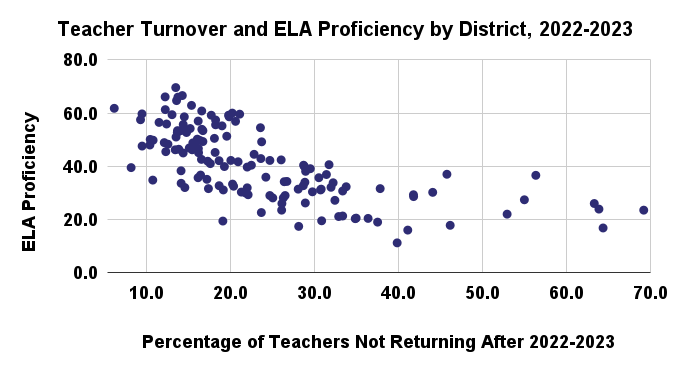
But these statewide averages do not tell the full story. Attrition rates vary substantially by district, with some losing over half of their teachers—while others lost less than 10%. These varying rates of teacher turnover also appear to be closely related to student achievement. Figures 1 and 2 compare the attrition rate of each district in 2022-2023 with the percentage of students in each district scoring proficient on the 2022-2023 MAAP exams in ELA and math, respectively.

There is a strong, negative correlation between teacher attrition and proficiency rates in ELA and math. That is to say, the larger the attrition rate is for a given district, the lower we would expect the proficiency rates to be. The strength and direction of the correlation can be measured by the Pearson correlation coefficient, which is expressed as a number between -1 and 1 (with numbers closer to zero indicative of a lack of any relationship). The correlation coefficient for teacher attrition and ELA proficiency is -0.67, and for teacher attrition and math proficiency is -0.67.
Of course, correlation does not necessarily imply causation, and we do not have sufficient data to confirm any causal link specifically between district attrition rates and proficiency levels on the MAAP exams in 2022-2023. That being said, research on teacher attrition is quite clear that high rates of turnover negatively impact student achievement by causing districts to restrict course offerings, increase class sizes, or hire inexperienced teachers. Turnover is also expensive: a 2007 study on attrition patterns in a handful of districts nationwide found that, between recruiting, hiring, and training replacements, districts can effectively lose up to $17,872 (over $26,000 in inflation-adjusted 2023 dollars) for each teacher lost.
The high rate of teacher turnover in many districts across Mississippi poses a significant challenge to raising student achievement, and it may explain, at least in part, why certain districts have failed to make meaningful progress towards improving proficiency rates in recent years. The strong association between teacher attrition and student achievement suggests that we can better serve students in Mississippi’s highest-need areas by taking steps to help struggling districts recruit and retain highly-effective teachers.
Teaching Experience
The percentage of “experienced teachers” in a given district—defined by MDE as teachers with at least four years of experience—also appears to be closely related to student achievement. On average, 72.7% teachers in a given district are “experienced” under this definition, but again there is tremendous variation. Figures 3 and 4 compare the percentage of experienced teachers in each district with the ELA and math proficiency rates, respectively.
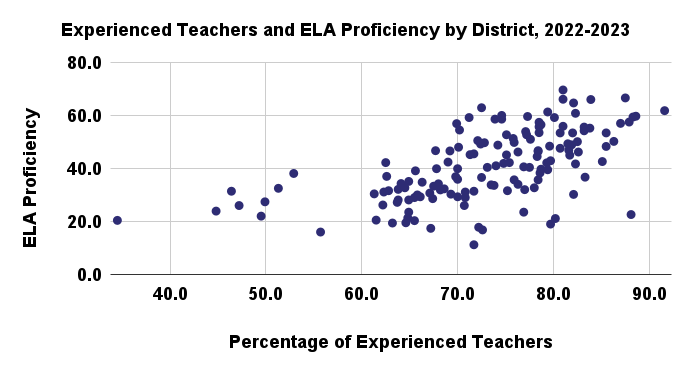

There is a strong, positive correlation between the percentage of experienced teachers in each district and proficiency rates in ELA (correlation coefficient of 0.60) and math (0.62). The strength of these relationships is similar to that between proficiency rates and attrition rates, but in this case the relationships are positive: the larger the proportion of experienced teachers in a given district, the higher we would expect proficiency rates to be.
Again, our data set is limited, and there is not sufficient evidence here for a causal relationship between the proportion of experienced teachers and proficiency levels on MAAP exams in 2022-2023. In all likelihood, the relationship between teaching experience and student achievement is, at least in part, explained by teacher turnover, or vice-versa (districts with high turnover tend to rely more heavily on inexperienced teachers).
But there is a substantial research base elsewhere for the relationship between teaching experience and student achievement that we can reasonably impute some assumptions from other studies to the Mississippi context—and this research suggests we need to take seriously the wide disparity in access to experienced teachers. For example, a 2016 review of the research on this subject found a similarly positive relationship between teaching experience and student achievement across 28 out of 30 peer-reviewed studies. Often, the impact of additional teaching experience was the greatest in teachers’ early careers (there can be a steep learning curve in teaching), and studies also found that experienced teachers had a positive impact on their less experienced colleagues as well (more opportunities for mentoring).
Applying these findings to the Mississippi context—where we know that there are fewer experienced teachers in low-performing districts—we can, at the very least, say with certainty that students in our highest-need areas are not well-served by the current distribution of teachers across the state.
Provisional Licenses and In-Field Teachers
MDE also tracks the number of teachers in each district with a provisional license (also known as an emergency license) as well as those who are teaching “in-field.” Both the proportion of provisionally licensed teachers and the proportion of in-field teachers in a district are strongly correlated to proficiency rates, though the implications of these relationships are somewhat less informative for the sake of raising student achievement.
A provisional license can be requested by a district for a prospective teacher who has completed some, but not all, of the requirements for a standard Mississippi license. Often, these are prospective teachers who have completed an educator preparation program but are being hired to teach a separate subject from their training, or have yet to pass the requisite subject area assessment. In-field teachers are those who are teaching courses for which they are properly endorsed. As you might expect, the proportion of provisionally licensed and in-field teachers in a given district are inversely related—districts with a high proportion of provisionally licensed teachers have fewer in-field teachers, and vice-versa (though our analysis of MDE data suggests there are a handful cases in which teachers are counted as both teaching in-field and on a provisional license).
Figures 5 and 6 compare the percentage of provisionally-licensed teachers in each district with proficiency rates. Figures 7 and 8 compare the percentage of in-field teachers in each district with proficiency rates.


There is a strong, negative correlation between the proportion of teachers with a provisional license in each district and proficiency rates in ELA (correlation coefficient of -0.58) and math (-0.62), and there is a strong, positive correlation between the percentage of in-field teachers in each district and proficiency rates in ELA (correlation coefficient of 0.48) and math (0.53). Generally speaking, the higher the proportion of in-field teachers and the lower the proportion of provisionally licensed teachers in a given district, the higher we would expect proficiency rates to be.
In addition to the standard “correlation is not causation” caveat, we have reason to be somewhat more cautious in drawing policy implications from this relationship. To start, research on the link between licensure status and student achievement is mixed. It is generally well established that certification exams for teachers do not predict their effectiveness in the classroom—but this is only one component of earning a teaching license, and does not amount to evidence that licensure status is irrelevant. There are studies that have found a link between licensure status and student achievement but often the licensed teachers in these studies also have a minimum level of teaching experience (which we previously established is also strongly correlated to proficiency levels).
The question of whether licensed teachers are more effective teachers is ultimately about the relevance of the qualifications for earning a license—and this question is complicated in Mississippi because those qualifications have shifted somewhat in recent years (in particular, easing entrance requirements for educator preparation programs, easing the process of reciprocity for out-of-state applicants, and the creation of a performance-based licensure pathway). In short, the difference between a teacher with a standard license and a teacher with a provisional license can be highly variable, and it is difficult to isolate and identify the particular characteristics of provisionally licensed teachers which may explain why districts with high proportions of these teachers have lower proficiency rates.
It is notable that lower-performing districts have a higher proportion of provisionally licensed teachers (and, relatedly, a lower proportion of in-field teachers), but this finding alone does not support any major changes to licensure requirements or hiring practices. Rather, we would expect to see improvement in the proportion of provisionally licensed and in-field teachers as a result of a general strengthening of Mississippi’s educator pipeline.
Implications for Mississippi’s Educator Pipeline
Data from the Mississippi Succeeds Report Card reveal that there is a fundamental mismatch between the needs of school districts and the distribution of teachers across Mississippi. Districts with the lowest proficiency rates have the highest rates of teacher turnover as well as the highest proportions of teachers who are inexperienced, provisionally licensed, and/or teaching out-of-field. Whether or not the current distribution of teachers is causing these proficiency patterns is somewhat immaterial—at the very least, we know that it is not helping, and that is sufficient cause to change our state’s approach.
The primary obstacle to a more equitable distribution of teachers is that there are virtually no incentives to teach in the highest-need areas across Mississippi. These are challenging teaching assignments, often in rural areas, and any variation in compensation (the result of local salary supplements to the statewide salary schedule) tends to favor high-performing districts. Mississippi First has long argued for the state to provide a stipend to teachers in geographic critical shortage areas—a designation that is based on the percentage of teachers in a given district who are experienced, provisionally-licensed, and/or teaching in-field—and, in light of this analysis, we are more committed to this initiative than ever.
Two bills were introduced during the 2023 legislative session to provide a $2,000 stipend to teachers in critical shortage areas. Unfortunately, both Senate Bill 2319 and House Bill 1184 ultimately died in committee. Given the demonstrated need to improve recruitment and retention of educators in critical shortage areas across the state—as well as the fact that the average Mississippi teacher salary is currently at its lowest point of the 21st century—we hope that in 2024 legislators will consider providing a much-needed incentive to teach in Mississippi’s highest-need districts. Students, teachers, and communities are counting on them.
Related Posts

By Grace Breazeale | Director of Research and K-12 Policy This week, the National Center for Education Statistics released 2024 National Assessment of Education Progress (NAEP) assessment results, commonly referred to as the “Nation’s Report Card.” The assessment is administered across the nation every two years in grades 4 and 8. Unlike state-specific standardized tests, the NAEP […]

Editor’s Note: This is the second part of a two-part series on third grade literacy achievement. You can find the first part here. *** By Grace Breazeale | Director of Research and K-12 Policy In the first part of this series, we explored the effectiveness of the Literacy-Based Promotion Act (LBPA) across Mississippi school districts, as well […]

Editor’s Note: This is the first part of a two-part series on the Literacy-Based Promotion Act. *** By Grace Breazeale | Director of Research and K-12 Policy Between 2013 and 2019, fourth grade reading scores on the nationwide NAEP test increased by ten points in Mississippi–a larger increase than in any other state during this time […]
Editor’s Note: This blog post is in response to a column appearing in the LA Times titled “How Mississippi gamed its national reading test scores to produce ‘miracle gains.‘” We’re not going to link to it because we don’t believe it is worth your clicks; however, feel free to Google. *** This morning, I was […]

Editor’s Note: This blog post is part of an ongoing series of posts dedicated to K-12 education policy in Mississippi. *** By Grace Breazeale | Director of Research and K-12 Policy Mississippi’s high school graduation rate has steadily risen over the past five years, which would typically be a cause for celebration. But in this case, […]
Editor’s Note: This blog post is part of an ongoing series of posts dedicated to K-12 education policy in Mississippi. *** By Grace Breazeale | Director of Research and K-12 Policy In early 2021, the Mississippi Department of Education released its first-ever social-emotional learning (SEL) standards. The release of these standards was a positive step towards increasing […]
By Toren Ballard This fall, Mississippians received two widely divergent narratives about the state of public education post-COVID: On September 29, the Mississippi Department of Education (MDE) released school and district accountability grades for the 2021-2022 school year, showing unprecedented improvement: 87% of districts were rated “C” or higher, up from 70% in 2019, the last time MDE […]
By Rachel Canter | Executive Director When I was a first year teacher, I asked my students a basic question about American history—“Why do we celebrate Dr. Martin Luther King, Jr.’s birthday every year?”—as a way of introducing Dr. King’s “I Have a Dream” speech. Without exception, the answer I got from every class was that […]
Today, we released a statement on American history from our Executive Director, Rachel Canter. In partnership with that statement, Mississippi First has developed the following principles for assessing curriculum-related legislation. These principles are based on our organizational values. We believe these principles are commonsense. In a recent nationwide poll of parents, large majorities of both Republicans and Democrats agreed […]
By Rachel Canter Yesterday, we did a thread to explain school grades. Here’s some additional information about growth because it is the hardest part to understand. Usually, when schoolwide proficiency goes up, growth will go up as well, BUT it is possible to have higher proficiency scores schoolwide from one year to the next and still have a […]
By Rachel Canter School grades came out unofficially yesterday, and we’re already seeing (sometimes uninformed) chatter about what they mean. Here are a few pointers: Our state accountability system is based mostly on how well kids do on their end-of-year tests. The end-of-year tests are given in reading and math to all kids in grades 3-8, […]
Jackson, MS—Today, Mississippi First released Understanding District and State Testing in Mississippi. This report uses field research on testing practices in four diverse Mississippi school districts to determine how many tests Mississippi students take and how much time they spend taking those tests. It also describes common school district testing practices, such as how testing is conducted and […]