



Nothing in the Pipes: Educator Crisis in Misssissippi

In recent years, a new problem in a decades-old challenge has emerged: the number of new Mississippi teachers has sharply declined, exacerbating the teacher shortage and threatening the success of public education in Mississippi.
In this investigation, Mississippi First examines the state of Mississippi’s educator pipeline, specifically how the number and diversity of candidates completing educator preparation programs have changed. We then present evidence showing how the rising cost of college attendance and the declining value of teacher salaries may be squeezing aspiring new teachers out of the profession. Finally, we offer a menu of recommendations for policymakers to address these interrelated financial barriers and reverse the alarming downturn in new teachers.
Nothing in the Pipes: Educator Crisis in Mississippi
The number of new Mississippi teachers has sharply declined, exacerbating the teacher shortage and threatening the success of public education in Mississippi.
High-Level Findings

After years of relative stability, Mississippi’s pre-service educator pipeline is suddenly drying up–fast.
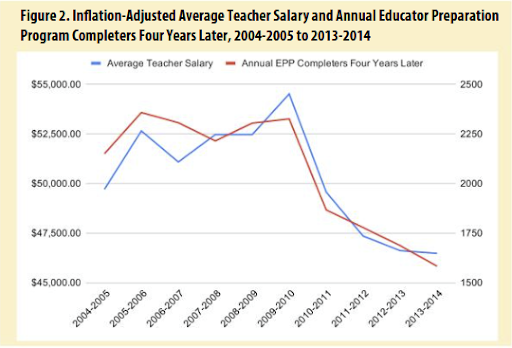
The growing “pay penalty” for Mississippi teachers–the result of stagnant salaries–may be forcing would-be teachers to move out of state or choose a new profession entirely.

Not only do aspiring Mississippi teachers have lower salaries to look forward to, they also have to pay more for the privilege, due to the skyrocketing cost of college and disappearing teacher-specific financial aid.
Stagnant salaries and sky-high tuition are forcing teachers to accept a lower standard of living–hardly the conditions necessary to reverse the rapidly worsening teacher shortage.
Policy Recommendations

Recommendation One
Raise teachers’ standards of living and the overall prestige of the teaching profession in Mississippi by providing for an across-the-board raise in teacher salaries of at least $3,000.

Recommendation Two
Incentivize current and aspiring teachers to teach where they are most needed by establishing a $3,000 stipend for all teachers in critical shortage areas.

Recommendation Three
Attract undergraduates into the educator pipeline by establishing an undergraduate grant program for juniors and seniors in educator preparation programs. Incentivize these individuals to teach in critical shortage areas by offering loan repayment assistance.
Authors

Toren Ballard, Director of K-12 Policy, 2019-2025

Rachel Canter, Executive Director, 2008 – 2025
SEE MORE REPORTS & PUBLICATIONS

Mississippi First has released a new report, The Weight They Carry: Life as a Teacher in Mississippi, which examines the conditions shaping teachers’ day-to-day experiences and their decisions about whether to remain in the classroom. Based on survey responses from nearly 1,000 Mississippi teachers across more than 120 school districts and charter schools, the report […]

A year after the historic raise, Mississippi continues to see high levels of teacher turnover. We turned back to our reliable tool, surveying teachers, to confirm our hypothesis that record inflation, which reached a peak in 2022, was cutting into the gains promised by the teacher salary increase. With the 2022-2023 Mississippi Teacher Survey, we […]

“Eyeing the Exit: Teacher Turnover and What We Can Do About It” provides a nuanced look at which Mississippi teachers are leaving the classroom and why. Central to the report is our examination of attrition risk and teachers’ standard of living to make the case that financial insecurity drives teachers’ desire to exit the classroom […]

In our previous report, Nothing in the Pipes: Educator Crisis in Mississippi, we explained how the rising cost of college attendance and the declining value of teaching salaries may be squeezing aspiring new teachers out of the pipeline. To build on that analysis, we surveyed 6,496 Mississippi teachers to establish the state’s most comprehensive resource for understanding […]