



The Potential of Career Advancement Opportunities for Teachers
Editor’s Note: This blog post is part of an ongoing series of posts dedicated to K-12 education policy in Mississippi.
***

By Grace Breazeale | Director of Research and K-12 Policy
The Potential of Career Advancement Opportunities for Teachers
Despite recent wins for public education in Mississippi, maintaining a strong and stable teacher workforce remains an issue. According to data from the Mississippi Department of Education, approximately one-fifth of the state’s public school teachers chose not to return to their position after the 2022-2023 school year. When students entered the classroom at the start of the 2023-2024 school year, there were a total of 2,775 teacher vacancies in public schools across the state.
A complex web of factors play a role in a teacher’s choice to stay in the classroom. Developing and maintaining a strong teacher workforce involves examining and improving these individual elements to ensure that teaching is an attractive profession. In recent reports, we analyze the role that teacher compensation can play in a teacher’s career decisions and present convincing evidence that a teacher’s financial stability is related to their likelihood of leaving the profession. In this post, we begin examining a related but distinct factor: the lack of opportunity for promotion and career progression for teachers who stay in the classroom.
Lack of Career Advancement Opportunities
Teachers have a heavy workload. In addition to delivering instruction, they are responsible for planning lessons, finding and preparing instructional materials, providing interventions to struggling students, contacting parents, creating assessments, grading assessments, analyzing student data, maintaining an organized classroom, and more. In addition, they are often tasked with secondary responsibilities, such as working at school athletic events or monitoring students during arrival and dismissal. Teachers do not have a ramp up to this workload: a teacher with twenty years of experience, ten years of experience, and zero years of experience typically all have the same responsibilities. As a US News article puts it, this workload can “feel frantic for novices” and can be “a waste of many veterans’ institutional knowledge.”
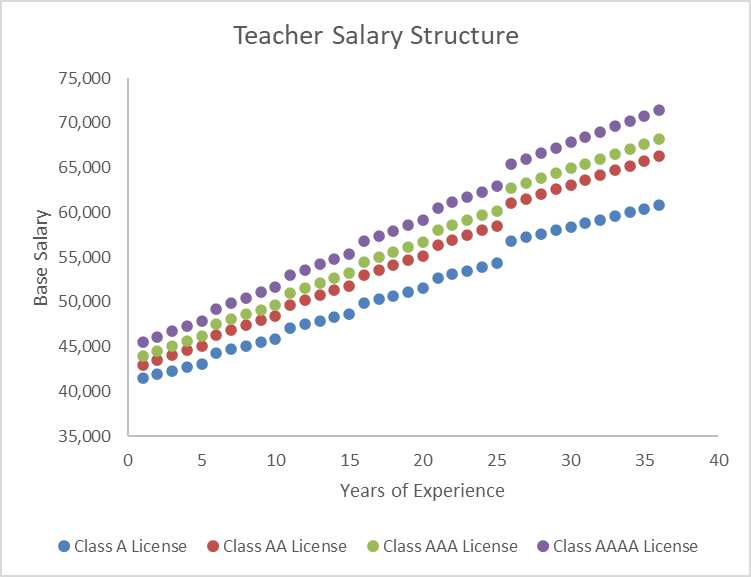
The relatively monolithic nature of the teaching profession also leaves little room for salary increases outside of a prescribed structure. In Mississippi and most other places in the United States, teachers’ salaries have a “step-and-lane” structure: as a teacher gains more years of experience, their salary increases (“steps”), and if a teachers completes higher levels of education above a bachelor’s degree, their salary increases (“lanes”).
While there are additional factors that can impact teacher pay, the step-and-lane structure of the salary schedule is generally maintained even as the actual amount of teachers’ salaries may change. For instance, teachers in different districts may receive different salary supplements, but this does not change the pay bumps that come with additional years of experience or additional degrees.
If an experienced teacher wishes to have more responsibility and a higher salary, they can most easily accomplish this through leaving the classroom to become a school administrator or instructional coach. It is thus plausible that the lack of opportunities for career growth may contribute to effective teachers exiting the classroom or college students deciding not to enter the teaching profession in the first place.
Results from Mississippi First’s 2022 Mississippi Teacher Survey indicate that a large percentage of teachers may be seeking additional responsibilities and higher salaries within the field of education—opportunities that are not generally available to teachers who wish to stay in the classroom. In total, one in four respondents (25.9%) reported that they were “somewhat” or “very” likely to leave the classroom within the next year to take another role in education. The percentage of teachers considering this route was even higher among non-White teachers (36.6%), teachers with an advanced license (33.1%), teachers with 6-11 years of experience (30.5%), and teachers with 12-17 years of experience (31.1%).
Likelihood of Taking Another Role in Education

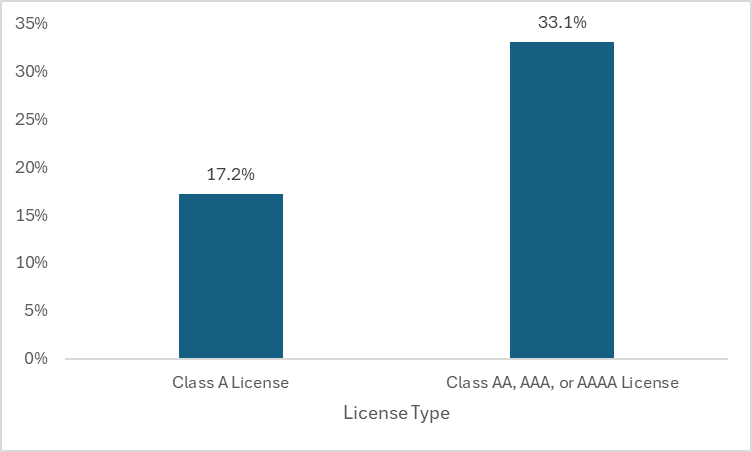
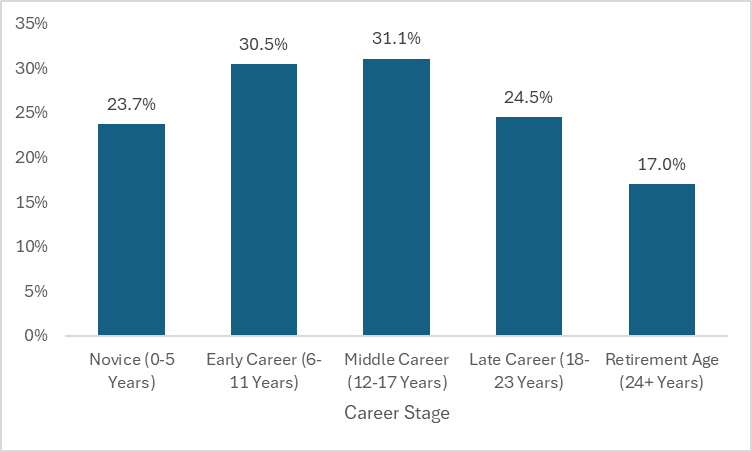
Note: The differences between subgroups in each graph are statistically significant.
These “likely leavers” wish to stay in education, but they may be tempted to leave the classroom to gain the financial benefits and professional fulfillment of taking another role in the field. In many districts, leaving the classroom is the only path towards true career advancement.
Possible Reform: Teacher Leadership
The creation of a career ladder for teachers could help mitigate the issues outlined above. While there are different iterations of what this looks like in practice, it generally involves teachers taking on additional responsibility within the school and receiving a higher salary in return. Additional responsibilities may include coaching other teachers, leading professional development activities, teaching larger classes, and more.
Leadership pathways for teachers are the norm in other locations such as Shanghai, Singapore, and Australia. In Singapore, educators begin as classroom teachers. When a teacher and their supervisor agree that they are ready for more responsibility, the teacher can choose among three career ladders: a teaching track, a leadership track, or a specialist track. Teachers who wish to remain in the classroom generally select the teaching track. As teachers progress along this track, they are given additional responsibilities such as mentoring new teachers and leading professional development sessions. A portion of their teaching responsibility is offloaded so that they have capacity for these additional responsibilities. They also receive a higher salary as they move along the track. In theory, this structure increases teachers’ motivation through putting them in charge of their career progression.
Despite teacher leadership being relatively rare in the United States, policymakers and researchers have explored this reform for decades. In recent years, it has gained traction in districts across the country. Below, we outline the history of teacher leadership as a policy idea in the United States and provide an overview of research on its effectiveness.
Career Ladders for Teachers: Not a New Idea
The idea that the structure of the teaching profession should be reformed is not a new concept in the United States. In A Nation at Risk, the seminal report put out by the National Commission on Excellence in Education in 1983, the US Secretary of Education noted that “the professional working life of teachers is on the whole unacceptable.” It goes on to offer a solution to this issue: “school boards, administrators, and teachers should cooperate to develop career ladders for teachers that distinguish among the beginning instructor, the experienced teacher, and the master teacher.” Dialogue and policy actions in the years that followed continued to build on the idea that allowing more paths for teachers’ career development would strengthen the profession.
In the mid-1980s, for instance, Utah implemented a career ladder in which teachers could take on extra work within the school to increase their salaries. A 1987 study found that teachers in Provo, Utah felt “basically but not overwhelmingly” positive, indicating that the approach held promise but may not be the silver bullet to improving the teacher workforce.
Missouri was another early state to incorporate leadership roles into the teaching profession and began implementing its “Missouri Career Ladder Program” during the 1986-1987 school year. The program, which was still in effect as of March 2023, also allows teachers to take on additional work for additional compensation. A 2009 study found evidence that the program positively impacted teacher retention, particularly for mid-career teachers.
Other research, though not directly focused on a teacher career ladder, can be examined to evaluate the potential of teacher leadership roles. A 2016 study on schools in Tennessee found that when high-performing teachers coached low-performing teachers, students in the low performing teachers’ classroom increased their scores–which persisted past the year of mentorship.
Similarly, a 2018 meta-analysis from researchers at Harvard and Brown examined the impact of teacher coaching. It found that this could have strong positive effects on the instructional practices of the teachers being coached (and smaller positive effects on student achievement), if they were implemented with fidelity. As most teacher leadership roles involve teacher leaders mentoring less experienced or less effective teachers, these papers both support the notion that this practice could have a positive impact on schools.
Case Study: Opportunity Culture
A recent example of a teacher leadership reform known as “Opportunity Culture” was first implemented in several schools of the Charlotte-Mecklenburg School District (CMSD) during the 2012-2013 school year. There are multiple facets of Opportunity Culture, but one of the primary characteristics is that teachers can apply to become “multi-classroom leaders” (MCLs) in their schools. In this role, these teachers still have their own classes, but they are also responsible for coaching other teachers within the school. The intended outcome is for the MCLs to impact more students through the coaching of other teachers. As of the 2022-2023 school year, more than 800 schools throughout the county used an Opportunity Culture model.
While there are few academic studies on Opportunity Culture–possibly due to it being a relatively new initiative–a 2018 study found that it did have a positive impact on students’ math achievement, but no impact on their reading achievement. An evaluation of this type of program in North Carolina, commissioned by the state’s Department of Public Instruction, also found a positive impact on math scores but no impact on reading scores, with the greatest impacts on math occurring in schools that had implemented the reform for at least five years. The evaluation also included data indicating that teachers and school leaders had a generally positive view of the reform, with many teachers reporting that having the opportunity to lead other teachers was one of the reasons they were still in the classroom.
Teacher Leadership in Mississippi
The concept of teacher leadership could hold promise for Mississippi’s teacher workforce. It appears that the Mississippi Department of Education has shown interest in the past in this type of reform: an analysis from the National Council on Teacher Quality notes that, as of 2019, the state reported that it had an initiative piloting teacher leadership programs in several districts. The status of this pilot is unclear: while it appears that some school districts do implement teacher leadership roles in some capacity (as evidenced by “Lead Teacher” career listings), we are unable to confirm whether these roles are a result of MDE’s pilot program or if the pilot program is still ongoing.
The same year that NCTQ reported on Mississippi’s teacher leadership pilot program, 2019, there was a House bill and a Senate bill in the state legislature that would have established a teacher leadership pilot program in statute. Given the timing of these bills, it is possible (and even likely) that this legislation was intended to bolster the MDE pilot. As we continue to examine the potential of a teacher leadership reform, we plan to look further into the history of this legislation, the current status of MDE’s teacher leadership program, and the current appetite for this type of initiative.
Related Posts

After yesterday’s legislative committee deadline, all bills that would have led to a pay raise for Mississippi teachers are now dead. While not all hope is lost, the pathway to a permanent raise has narrowed. We are extremely disappointed that this long-overdue salary increase may become a casualty of political infighting. Earlier this year, Mississippi […]

FOR IMMEDIATE RELEASEMississippi FirstKrystal CormackDirector of Communicationskrystal@mississippifirst.org601.398.9008 Jackson, Mississippi—Today, Mississippi First released its newest report, The Weight They Carry: Life as a Teacher in Mississippi, an analysis of the conditions shaping Mississippi teachers’ day-to-day experiences and their decisions about whether to remain in the classroom. Based on survey responses from nearly 1,000 Mississippi teachers across […]

By Toren Ballard For the second year in a row, results from the Mississippi Academic Assessment Program (MAAP) exams suggest that Mississippi is continuing to defy nationwide trends in educational achievement: proficiency levels across all subjects were at all-time highs in 2023, and Mississippi is now one of just two states nationwide to have exceeded its pre-pandemic proficiency […]

Editor’s Note: This blog post is part of an ongoing series of posts dedicated to K-12 education policy in Mississippi. *** By Grace Breazeale | Director of Research and K-12 Policy In this Post: What Factors Influence a Teacher’s Salary? In recent reports—including Falling Behind, which we released earlier this month—we have presented evidence that a […]

Jackson, Mississippi—Mississippi First, a non-profit organization dedicated to improving education in the state, has released a new report titled Falling Behind: Teacher Compensation and the Race Against Inflation. The report provides a comprehensive look at the complex factors contributing to Mississippi’s teacher shortage with emphasis on how inflation has directly affected the impact of the recent […]

Editor’s Note: This blog post is part of an ongoing series of posts dedicated to K-12 education policy in Mississippi. *** By Grace Breazeale | Director of Research and K-12 Policy A growing body of research indicates that students of color benefit when their race or ethnicity is represented in the teacher workforce. Unfortunately, Mississippi’s teacher workforce does not reflect the […]

Editor’s Note: This post is one in an ongoing series of posts dedicated to early education policy in Mississippi. *** By Micayla Tatum, Director of Early Childhood Policy A lack of wage parity is a longstanding issue in the early childhood profession. Childcare teachers, Head Start teachers, and public pre-K teachers have vastly different salaries and access […]

Editor’s Note: This blog post is a part of a new ongoing series of posts dedicated to K-12 education policy in Mississippi. *** By Grace Breazeale | Director of Research and K-12 Policy Teacher compensation has rightfully taken center stage in the effort to address the teacher shortage crisis in Mississippi. Still, there remains a host […]

Editor’s Note: This post is one in an ongoing series of posts dedicated to early education policy in Mississippi. *** By Micayla Tatum, Director of Early Childhood Policy The educator pipeline crisis, which Mississippi First has researched extensively, also affects childcare centers, Head Start, and public school pre-K programs. In short, finding early childhood teachers is as […]

Jackson, MS—Today, Mississippi First released our newest report, Eyeing the Exit: Teacher Turnover and What We Can Do About It. This report takes a deeper dive into data first reported in our February 2022 report Voices of the Shortage: 2022 Mississippi Teacher Survey, which revealed that over half of teachers surveyed reported being “somewhat” or “very likely” to […]
Editor’s Note: This blog post is a part of a new ongoing series of posts dedicated to K-12 education policy in Mississippi. *** By Grace Breazeale | Director of Research and K-12 Policy School and district leaders can be heavily influential in shaping the experiences of teachers, who in turn influence the strength of the educator […]
Editor’s Note: This blog post is part of an ongoing series of posts dedicated to K-12 education policy in Mississippi. *** By Grace Breazeale | Director of Research and K-12 Policy A growing student debt crisis may be contributing to Mississippi’s critical teacher shortage. Mississippi First’s 2022 Teacher Survey, completed by 6,496 teachers across Mississippi, provides clues about […]